
How to Achieve Cloud Cost Optimization with the AWS Well-Architected Framework
Introduction
An important pillar of the AWS well-architected framework, cost optimization is one of the most popular, and pertinent objectives in cloud computing today. This article covers the principles of cost optimization and technical must-do’s to achieve a cost optimized infrastructure.
Definition of cost optimization
Cost optimization means delivering business outcomes at the lowest price point possible.
It's not just about cost-cutting, cost reduction, or cost savings - while optimizing your workloads, solutions, and architecture for cost, you must ensure that you are still delivering necessary business outcomes. Whether it's availability, efficiency, customer satisfaction, or other factors, the goal is to achieve these outcomes at the lowest possible price.
How does the the Well-Architected Framework drive cost optimization?
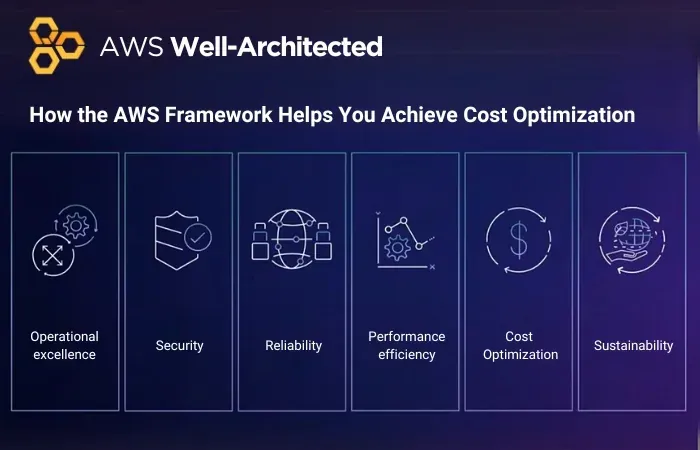
The well-architected framework is built around six pillars and provides a consistent approach for customers to evaluate their architectures and implement scalable designs. It guides users through a series of best practices and provides a consistent way to measure progress.
These best practices are not dictated by AWS, but are based on collective feedback from years of working with customers and partners. Incorporating these pillars helps create stable and efficient systems, reducing firefighting and wastage, ultimately leading to cost savings.
5 Design Principles of AWS Cost Optimization
There are five key design principles that should guide you as you optimize your workload for cost. These principles help you adopt the right mindset for optimizing cloud costs, leveraging AWS capabilities while freeing you from traditional cost constraints.
Cost optimization design principles
- Practice cloud financial management
- Adopt a consumption model
- Measure overall efficiency
- Stop spending money on undifferentiated heavy lifting
- Analyze and attribute expenditure
Investing the right amount of effort in a cost optimization strategy upfront enables you to realize the cloud’s economic benefits. It ensures consistent adherence to best practices and prevents over-provisioning from the start.
A common question from AWS users is, "We followed all the best practices for cost optimization—when do we stop?" The answer is that cost optimization is a continuous process over the lifetime of a workload. A workload that is cost-optimized today may not be cost-optimized three months down the line due to changes in functional requirements, evolving circumstances, or new AWS service offerings that better fit your needs.
Fortunately, WAFR don't cost anything to run, and AWS customers usually receive credits for each workloads reviewed. Connect with us to schedule a review >>
There are times when slowing down on cost optimization efforts makes sense as you achieve your objectives. In this case, continue to follow the design principles and establish standardized processes and automation. Though you divert your energy towards innovation and other projects, it’s important to revisit cost optimization journey periodically.
The bottom line is there is no magic bullet to becoming fully optimized in one go.It’s a gradual process through taking targeted actions.
Cost in Context
Take a look at the cost chart below. The thin purple bars in the background are your AWS bill over time. If you take it as an absolute number without any context, it's easy to conclude that expenses are increasing, leading to “bill shock”, and then internal discussions about lowering costs.

Instead, change the question from "What’s my cost?" to "What’s my cost per business
metric?" This could be cost per customer, per subscription, per website view, or other metric depending on your business. The business metric may be something that drives revenue in your company and therefore more meaningful.
Now, let's explore a few key levers to drive that metric down and move in the right direction.
Phase 1: Practice Cloud Financial management
→ Create a cost-aware culture and implement cost-aware processes
When designing your application architecture, such as an MVP or a greenfield solution or workload, you might create your account focusing on the right architectural pattern and the technology or services that will be used. However, you already need to practice cloud financial management at this stage with programs across your organization to establish a partnership between finance and engineering.
It is also critical for engineering teams to be responsible and select cost-effective resources.
How do I select the right cost-effective resources in phase 1?
The key to cost savings is designing your application architecture using services that meet your business requirements. However, you can't be absolutely optimized for cost while ignoring the other pillars.

This means you have to consider tradeoffs for cost to ensure you have the right balance with the other five pillars of well-architected. When the pillars are balanced, you reap the benefits of the cloud with a solid foundation base on which to build.
Choose cost-effective resources according to:
Geography - Pricing is different in each AWS region so while a best practice is to use cloud computing resources closer to your users for lower latency, you may also consider other regions for cost benefits if there’s alignment with your business requirements
Managed services - Consider the time savings gained by allowing teams to focus on retiring technical depth and innovating using AWS’ value added features.
- Compute - Services such as Elastic Beanstock, ECS, EKS, Lambda and Fargate give you the benefit of scale, performance and cost, enabling you to reduce your overhead.

- Databases - AWS offers multiple database services. If you’re migrating traditional relational databases (such as PostgreSQL, Oracle, SQL Server, MariaDB, MySQL), you could consider moving to Amazon RDS or Aurora. If you’re moving a non-relational database or if your application allows you to use non-relational database, you have numerous options (DynamoDB, DocumentDB, ElastiCache, Keyspaces). If you must be on-premises due to application latency or residency requirements, you could opt for Outposts or RDS on VMware to achieve cost optimization.

- Services to reduce data transfer costs - Consider networking in your application architectures and how to reduce transfer cost in and out. Leverage caching and compression or use a CDN like Amazon CloudFront, to keep data transfer costs down.

Storage - Use appropriate Amazon S3 storage classes based on access patterns (e.g., S3 Standard, S3 Glacier).
Where to begin with cost optimization implementation?
Familiarize yourself with the key optimization levers and address the low hanging fruit first.
The levers on the chart are displayed by complexity and TCO impact. While some are more complex to implement, they will give you a higher TCO impact.
Phase 2: Become aware of usage and expenditure
→ Gain visibility
If Phase 1 is about setting the right foundation, Phase 2 is about gaining visibility. You cannot optimize what you cannot see, and this is where many teams begin to understand how their cloud environment is actually behaving from a cost perspective.
At this stage, the objective is not to aggressively optimize. It is to build a clear, reliable picture of usage and spend so that future decisions are grounded in data, not assumptions.
Set up your account structure using AWS Organizations
Start by structuring your AWS accounts in a way that reflects how your business operates. This often means separating environments such as development, staging, and production, or organizing by team and workload.
A well-defined account structure makes it easier to isolate workloads, attribute costs accurately, and maintain control as your environment grows. It also enables consolidated billing, giving you a centralized view of spend across the organization. Without this structure, cost analysis quickly becomes fragmented and difficult to act on.
Establish cost controls
With structure in place, the next step is to introduce guardrails. These are not meant to slow teams down, but to prevent unnecessary or unintended spend.
This includes defining what services can be used, who has permission to create and manage resources, and how those resources must be tagged. Tagging, in particular, becomes essential. It transforms your cost data from a single number into something meaningful—costs tied to teams, applications, and business functions.
Prepare to monitor cost and usage
Once the environment is organized and controlled, you need to enable visibility. This means turning on the appropriate cost and usage tools and ensuring that you can track spend at a level that supports decision-making.
At this point, it is helpful to define a small set of metrics that matter to your business. Instead of only looking at total spend, begin thinking in terms of cost per workload, per team, or per business function. This aligns your cost data more closely with how your organization operates.
Perform basic monitoring of cost and usage
With visibility in place, begin reviewing your cost and usage data on a regular basis. The goal here is not precision, but awareness.
You are looking for signals such as unexpected increases in spend, resources that are consistently idle, or services that are growing faster than anticipated. These patterns often highlight areas where simple adjustments can have an immediate impact.
Setting up billing alerts is also important at this stage. While alerts will not catch every change, they provide an early indication when something moves outside expected thresholds, allowing you to respond before costs compound.
Manage demand and supply of resources
As visibility improves, you can begin aligning resource usage more closely with actual demand. This does not require complex changes. In many cases, it starts with straightforward actions—turning off non-production resources when they are not in use, adjusting scaling configurations, or identifying obvious opportunities to rightsize.
The goal is not to fully optimize the environment yet, but to reduce clear inefficiencies and establish control over how resources are consumed.
Phase 2 is where cost optimization becomes tangible. Once you understand how your environment is being used and where your money is going, you move from reacting to your AWS bill to actively managing it. That visibility is what enables more precise and impactful optimization in the next phase.
Phase 3: Optimize over time
→ Refine management with automation, guardrails, and modernization
If Phase 2 gives you visibility, Phase 3 is where you begin to act on it in a more structured and repeatable way. This is where cost optimization becomes an ongoing discipline rather than a series of one-off actions.
At this stage, you are no longer asking where your costs are coming from—you understand that. Now you are refining, tuning, and continuously improving how your workloads consume resources over time.
Establish detailed cost controls with enforcement and notifications
Basic guardrails from Phase 2 should now evolve into more defined controls with enforcement. This includes refining tagging strategies, tightening access controls where needed, and ensuring policies are consistently applied across accounts.
Notifications should also become more intentional. Instead of broad alerts, configure thresholds that reflect expected usage patterns so that deviations are meaningful and actionable.
Perform custom and deep analyses
With accurate data in place, you can begin deeper analysis of your environment. This goes beyond surface-level trends and into workload-level insights.
At this stage, teams often begin using Cost and Usage Reports (CUR) alongside analytics tools to answer more specific questions—what is driving cost growth, how usage patterns are evolving, and where inefficiencies persist.
This is also where cost starts to be evaluated in context of business metrics, such as cost per customer or cost per transaction, rather than as an isolated number.
Improve and reiterate your rightsizing strategy
Rightsizing becomes more deliberate in this phase. Instead of reacting to obvious inefficiencies, you begin to systematically evaluate compute, storage, and database usage across workloads.
This includes testing different configurations, validating assumptions with performance data, and making incremental adjustments. Rightsizing is not a one-time activity, but something you revisit as workloads evolve.
Select the right purchase options
As usage patterns stabilize, you can take advantage of AWS purchasing models more effectively.
This includes evaluating Reserved Instances and Savings Plans for predictable workloads, while continuing to use On-Demand and Spot for flexibility where needed. The goal is to align purchasing decisions with actual usage patterns, not forecasts alone.
Manage demand and supply over time
Resource management becomes more refined in this phase. Scaling policies, queue sizes, and throttling configurations should be tuned based on observed behavior, not default settings.
Small adjustments here can have a meaningful impact over time, especially for workloads with variable or spiky demand.
Build a repeatable review process
One of the most important aspects of Phase 3 is establishing a regular review cadence. This can include periodic cost reviews, architecture evaluations, or Well-Architected Reviews.
These reviews help ensure that optimizations keep pace with changes in your application, your usage patterns, and AWS service offerings.
Continuously modernize your architecture
As new AWS services and features become available, revisit earlier architectural decisions. In many cases, newer services offer better cost-performance tradeoffs than what was originally implemented.
Modernization, whether through serverless adoption, containerization, or purpose-built services, is often where the largest long-term cost efficiencies are realized.
Phase 3 is where cost optimization matures into a continuous process. Instead of chasing cost reductions, you are consistently aligning your architecture, usage, and purchasing decisions with your business goals.
The result is not just lower cost, but a more efficient, scalable, and adaptable cloud environment.
Conclusion
Think of AWS cost optimization as tuning an engine. You don't just remove parts to make it lighter; you fine-tune it to run efficiently while delivering peak performance.
Cost optimization in AWS is not a one-time exercise but a continuous process that requires regular assessment and strategic adjustments. Organizations should focus on maximizing efficiency rather than simply reducing costs by leveraging AWS tools, automation, and best practices.
Start with small steps, stay proactive with regular reviews, and focus on building a cost-aware culture. With the right approach, you'll be able to optimize performance while keeping expenses in check.
There will be times when you’re ready to scale down the manual process of cost optimization. By utilizing best practice design principles fand incorporating standardized reviews, you’ll set a reliable trajectory to maintain your cost optimized workloads.